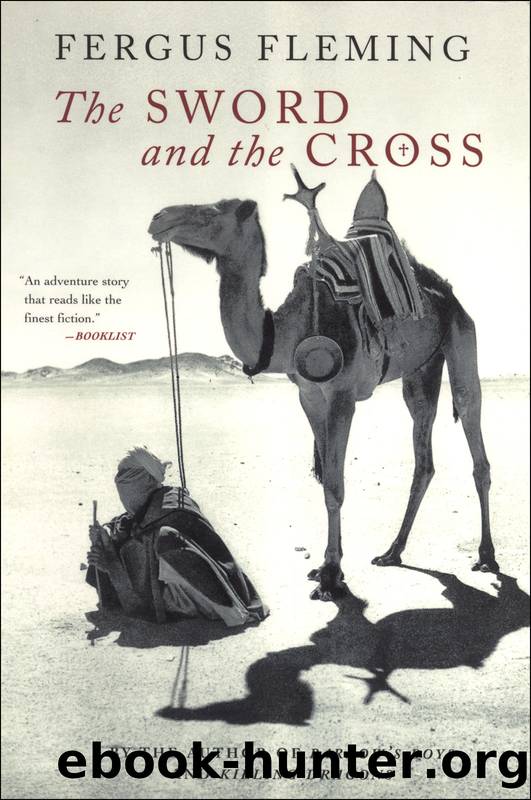
The Sword and the Cross by Fergus Fleming
Author:Fergus Fleming
Language: eng
Format: epub
Publisher: Grove Atlantic
Published: 2003-07-14T16:00:00+00:00
12
TOWARDS THE HOGGAR
As 1904 drew to a close, three figures could be discerned on the dusty track that ran from Ghardaia to El Goléa. They moved slowly and in a rough arrow-formation. The rearmost two were mounted on camels while, in the van, a lone individual plodded on foot, one hand hooked in his own camelâs reins. As they padded through the sand, the couple at the back maintained a desultory conversation. The pedestrian recited Hail Marys. At every oâclock one of the riders would strike the hour on a mess tin hanging from his saddle. Without breaking his stride the man in front would turn, nod his thanks, and then resume his litany. Charles de Foucauld (who had forgotten his watch) was guiding two White Fathers to El Goléa.
On New Yearâs Day 1905, the tinkling caravan reached its destination, where Laperrine came forward to greet it. Since parting from Foucauld in July the previous year, Laperrine had been busy. The tour of 1904 had not been an unqualified success. A number of Tuareg settlements had been âpacifiedâ and the Saharians had performed seamlessly. However, his efforts to place Foucauld in the Hoggar had failed â standing orders said that no priest could live in the Sahara unless they were near a garrison; and the same orders forbade the installation of a garrison south of the Tuat. Had Moussa invited him to stay, then that would have been a different matter. But Moussa had not appeared, which was in itself another problem, for Laperrine wanted very much to receive his submission on his own territory. Then there was the embarrassment at Timiaouine. In order to clear his name, sort out the status of the Iforas Tuareg and clarify the position of missionaries in Tuareg territory â also to have a holiday â Laperrine had gone to France. Expecting to be roasted for disobedience, he received a mild condemnation before being promoted to Lieutenant Colonel and told to keep up the good work. Now he was back in the Sahara with unfinished tasks in mind.
At El Goléa, and on the road back to Adrar, Laperrine painted sweeping pictures of political and religious conquest. There would be another tour of pacification in 1905, this time commanded not by himself but by a new man he had installed at In Salah, Captain Jean Dinaux. He assured his companion that Dinaux was extremely capable and just the man to locate Moussa and find Foucauld a home in the Hoggar. Once settled amidst the Tuareg, Foucauld would become a magnet for other evangelists. White Fathers, White Sisters: all were welcome. They would flock to the place once they knew Foucauld was there. And the authorities had no objection to his settling in the Hoggar. It was all arranged! But best not to talk of these things openly, lest word reach the ears of those who did not share their dreams. The two men ambled towards the Tuat in a roseate glow of conspiracy.
Before he went anywhere near the Hoggar, Foucauld wanted a restorative period at his Fraternity in Beni Abbès.
Download
This site does not store any files on its server. We only index and link to content provided by other sites. Please contact the content providers to delete copyright contents if any and email us, we'll remove relevant links or contents immediately.
The Vikings: Conquering England, France, and Ireland by Wernick Robert(84525)
Ali Pasha, Lion of Ioannina by Eugenia Russell & Eugenia Russell(40375)
The Conquerors (The Winning of America Series Book 3) by Eckert Allan W(38676)
The Vikings: Discoverers of a New World by Wernick Robert(37043)
Cecilia; Or, Memoirs of an Heiress — Volume 1 by Fanny Burney(32708)
Cecilia; Or, Memoirs of an Heiress — Volume 2 by Fanny Burney(32072)
Cecilia; Or, Memoirs of an Heiress — Volume 3 by Fanny Burney(32054)
Empire of the Sikhs by Patwant Singh(23181)
The Secret History by Donna Tartt(19436)
Hans Sturm: A Soldier's Odyssey on the Eastern Front by Gordon Williamson(18706)
Cat's cradle by Kurt Vonnegut(15525)
Pimp by Iceberg Slim(14774)
Sapiens: A Brief History of Humankind by Yuval Noah Harari(14536)
Norse Mythology by Gaiman Neil(13536)
Talking to Strangers by Malcolm Gladwell(13515)
Leonardo da Vinci by Walter Isaacson(13471)
4 3 2 1: A Novel by Paul Auster(12596)
Underground: A Human History of the Worlds Beneath Our Feet by Will Hunt(12217)
The Radium Girls by Kate Moore(12165)
